Building leadership while staying true to yourself: a conversation with Dawn Marriott
In this episode of our Women in Leadership series at team.blue, we sat down with Dawn Marriott, Executive Chair at team.blue, to discuss her remarkable journey from leaving school at 16 to being part of a team leading a FTSE 100 company. Dawn's story is one of resilience, authenticity and the power of embracing your true self whilst building diverse, high-performing teams. Her leadership philosophy centres on a simple yet profound principle: work hard, stay curious and never pretend to be someone you're not.
Did you always know you wanted to lead?
According to my parents, I announced at Christmas, when I was five, that I was going to be the Prime Minister of England one day. What really shaped that ambition was seeing Margaret Thatcher become the UK's first female Prime Minister in 1979. I was eight years old, and I remember that day as if it were yesterday.
Even back in the 1970s, when diversity and inclusion weren't even concepts, seeing a woman in that position was incredibly inspiring. She became my role model, not just for her political power, but because she was smart, down-to-earth and humble. She left quite a legacy with me. In fact, I've been collecting handbags for 30 years because Margaret Thatcher also collected handbags.
By the time I was 15, I realised I didn't want to be a politician, but that early inspiration to be a woman in a powerful position clearly had an impact on me.
Your career path is quite unique. How did it all begin?
Unlike most people, I left school at 16. Back in 1980s England, university was mainly for people from wealthy families or for those whose parents were teachers. My mum worked at a doctor's office, my dad was a builder, so university never seemed like an option for me.
However, I didn't see that as a disadvantage. I saw it as freedom, because it meant I could get a job and be independent. I got my first job at 13, and by 18, I could afford a mortgage. On my 18th birthday, I signed for it and moved into my first house a week later.
Who were the influential people early in your career?
In my first job, I was lucky to encounter an exceptional female manager, whom I am still in touch with today. She taught me how to be a good colleague, how to care about people at work and how to behave in the right way with colleagues and customers. I owe so much of my career to her, because she set the standard for me and inspired me to achieve whatever I wanted.
I then spent almost 20 years at another company, helping it grow from small to 75,000 employees and £6.5 billion in revenues. What I learned most there was to know my own weaknesses and hire talented people around me who complemented the things I wasn't very good at. That combination of self-awareness and seeing strengths in others helped me build successful teams. It also meant I had a great deal of enjoyment at work, meeting and learning from so many different people.
What brought you to team.blue?
In January 2017, I joined Hg , the private equity firm that invested in team.blue. I have been CEO of two companies that required turnarounds. I'm now on the board of four companies, chairing three of them, including team.blue. I am also on two charity Boards.
What I love about team.blue is genuinely the people. This group is not just about providing digital products that make online business success simpler for our customers, but also about the talents in it: many brilliant women and men. The team.blue culture is the proof that when you have diverse teams with different skills, styles and backgrounds working together, that's when you see real success and have fun.
Looking back at your career, what are you most proud of?
I'm proud that I led a FTSE 100 company without a privileged upbringing or a university education. But what really resonates with me is that I'm still myself and proud of how hard I have worked.
Being true to yourself is one of the kindest things you can do for yourself at work and at home. If you try to be something you're not, you won't end up being very happy. People sometimes think I don't look like a chairwoman because I'm laughing, joking, wearing a bold outfit, chatting about my kids or my handbags. I am totally OK with that. Judge me for what I deliver, not for how I look or where I came from.
When I look back at my life, I'm happy that I have got faithful friends, a lovely blended family and loads of brilliant colleagues. That's what success looks like to me.
How do you balance your personal and professional responsibilities as a leader?
I'll be honest: it can be quite challenging sometimes. I have three kids, my partner has two kids, plus we have two grandchildren. You must be prepared to compromise and to be comfortable with that. The important thing to me is to be open about it. Don't feel you're going to be judged for it.
If I could go back and talk to myself in my twenties and thirties, I'd say: stop worrying about what everybody else thinks. It's acceptable to leave early sometimes. Learning to be tolerant, learning to balance things and being comfortable with who you are is fundamental.
What has been the most significant impact of mentorship on your career?
A pivotal moment in my career occurred in 1999, when I was leading a customer sales team at Capita. I had identified an opportunity to reshape the company’s business model, an idea that was not initially supported by my direct manager. I decided to present it to the Group CEO, despite being early in my career and lacking formal business school training.
Rather than dismissing the proposal, he asked a decisive question: “Do you believe you can deliver this yourself?” His confidence in my potential fundamentally changed my professional trajectory. Eighteen months later, I was appointed CEO of that business.
His mentorship was exceptional because it combined trust, guidance and autonomy. He consistently made time to listen, provided considered advice, and encouraged me to develop solutions independently. Having a mentor who recognises potential, offers strategic support and empowers independent growth is an invaluable asset.
As a leader who has navigated decades of technological change, what's your personal view on AI and its impact on leadership?
AI excites me. I'm not a technical person, but as leaders, I don’t think we need to be immediately experts in every technology. What we need is curiosity, a willingness to learn and the humility to ask questions.
What strikes me most is that AI reinforces the importance of the very human qualities that make great leadership. When AI can handle routine tasks, what becomes even more valuable is empathy, creativity and the ability to inspire people. AI frees us up to focus on what really matters: people and purpose.
I strongly believe that as leaders, our role is to embrace it with enthusiasm whilst creating environments where people feel supported to learn and experiment with it.
What advice would you give to someone starting their leadership journey?
Work hard but stay true to yourself. I grew my career because I kept saying yes to everything, even when I didn't have the knowledge and skills. I went and found them. But most importantly, just be yourself at work.
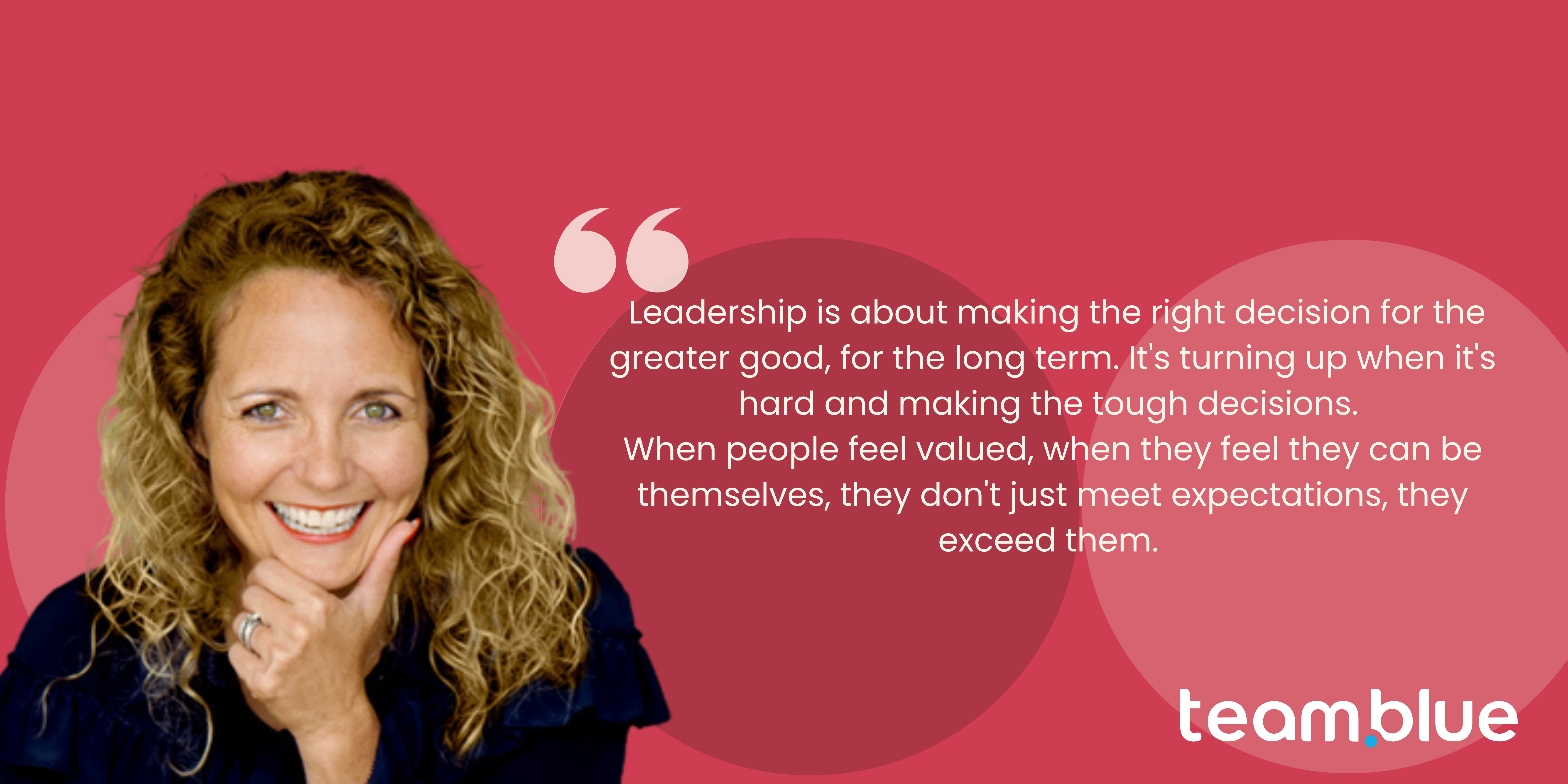
Leadership is about making the right decision for the greater good, for the long term. It's turning up when it's hard and making the tough decisions. When people feel valued, when they feel they can be themselves, they don't just meet expectations, they exceed them.